

Buy or Lease a Copier in Atlanta, GA
When your business needs a copier, one of the first decisions you’ll face is whether to lease a copier or buy one outright. It’s not a one-size-fits-all answer – and the wrong choice can cost your business thousands of dollars over time. This article walks you through the key differences between buying and leasing office copiers, helps you understand which option fits your cash flow and growth plans, and gives you a clear framework for making the right call.
Whether you’re a startup equipping your first office or an established company upgrading aging equipment, this guide is for any business owner, office manager, or operations lead trying to make a smart, cost-effective decision about their printing and copying needs.
Quick Answer: Leasing a copier is ideal for businesses that want low upfront costs, predictable monthly payments, and regular technology upgrades. Buying makes more sense if you have capital to invest, plan to use the equipment long-term, and want to avoid monthly obligations. Most small to mid-sized businesses benefit more from a copier lease.
What Is a Copier Lease – and How Does It Work?
A copier lease is a financing arrangement where your business pays a fixed monthly fee to use a copier or multifunction printer for a set period – typically 24, 36, 48, or 60 months. At the end of the lease term, you usually have the option to return the equipment, upgrade to a newer model, or in some cases purchase the machine at fair market value or for as little as $1 (depending on your lease type).
There are two main types of copier leases businesses should know about:
• Fair Market Value (FMV) Lease – Lower monthly payments. At the end of the term, you return the copier or buy it at its current market value. Best for businesses that want to stay current with technology.
• $1 Buyout Lease – Slightly higher monthly payments, but you own the equipment at the end for just $1. Best for businesses that want ownership without a large upfront investment.
Most copier lease agreements also bundle in service and maintenance, toner supply, and technical support – turning what could be an unpredictable expense into a simple, flat monthly line item. This is sometimes called a managed print services agreement, and it’s one of the biggest advantages of leasing over buying outright.
For growing businesses or those that rely heavily on printing and copying, a copier lease offers flexibility, lower barrier to entry, and access to enterprise-grade equipment that might otherwise be out of reach.
What Does It Mean to Buy a Copier Outright?
Buying a copier means paying the full purchase price upfront – or financing it through a traditional business loan. Once the purchase is complete, your business owns the equipment outright with no ongoing lease payments.
On the surface, ownership sounds appealing. But copier ownership comes with a set of responsibilities that are easy to overlook in the excitement of a one-time purchase:
• Maintenance and repairs are entirely your cost – parts, labor, and service calls add up quickly
• Toner, drums, and consumables must be purchased and managed separately
• Technology becomes obsolete – a copier purchased today may not meet your needs in 4 years
• Resale value is limited – office equipment depreciates rapidly and is difficult to sell
That said, buying a copier makes strong financial sense in specific situations. If your business has the capital available, uses the same equipment consistently over many years, and has an in-house IT or facilities team that handles maintenance, ownership can deliver a lower total cost over a long time horizon.
For businesses with stable, predictable copy and print volumes and no near-term plans to upgrade equipment, purchasing is a straightforward, no-strings-attached option.
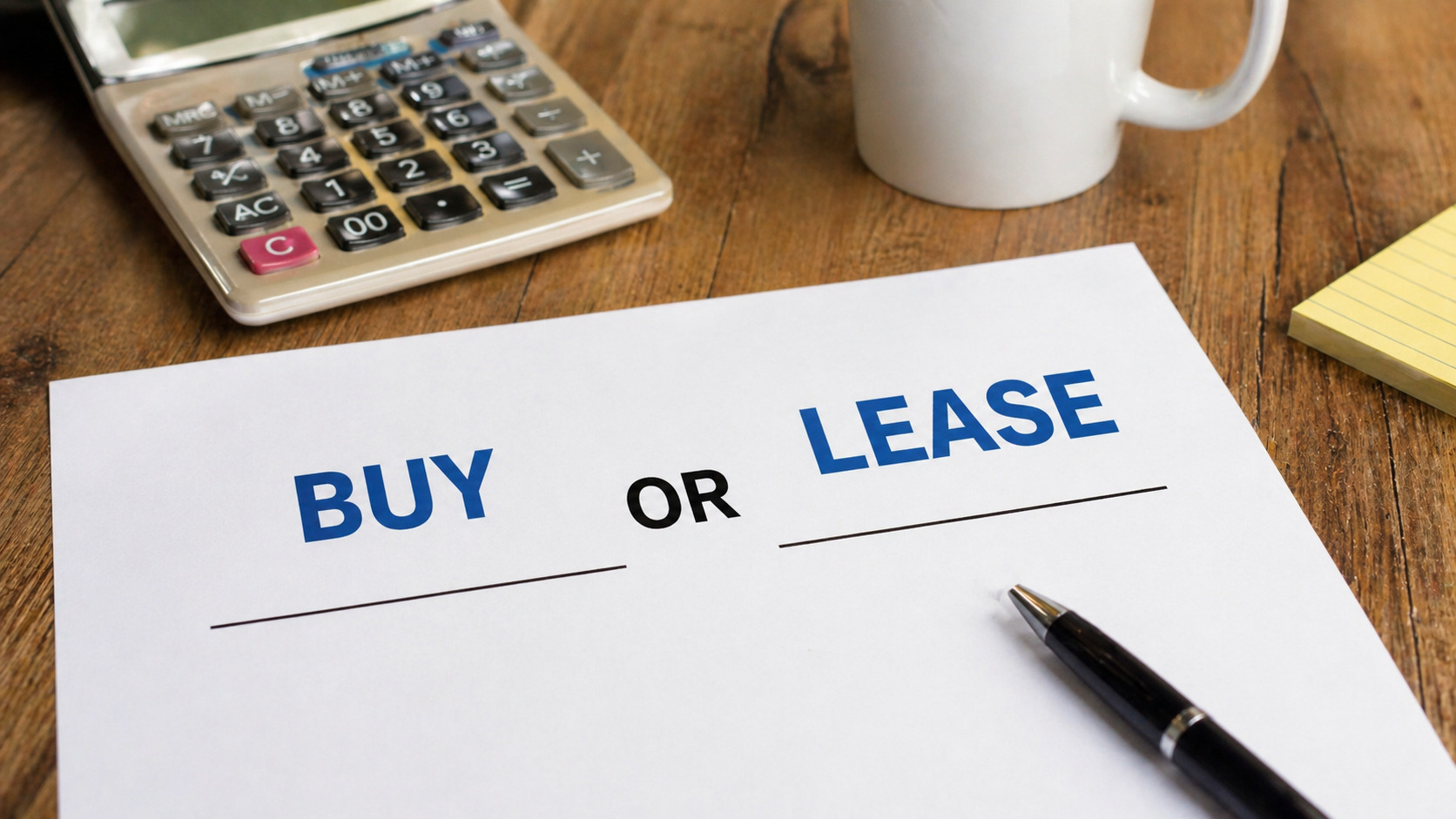
Copier Lease vs. Buy: Side-by-Side Comparison
Here’s a clear breakdown of how leasing and buying a copier compare across the factors that matter most to business decision-makers:
| Factor | Leasing a Copier | Buying a Copier |
| Upfront Cost | Low or $0 down | High – full purchase price |
| Monthly Payment | Fixed lease payment | None after purchase |
| Maintenance | Often included in lease | Your responsibility |
| Technology Upgrades | Easy – upgrade at end of term | You own aging equipment |
| Tax Treatment | Lease payments may be deductible | Depreciation deduction |
| Flexibility | Return or upgrade at lease end | Sell or keep – your choice |
| Best For | Growing businesses, tight cash flow | Stable businesses with capital |
| Ownership | No ownership | Full ownership |
As the table illustrates, neither option is universally better. The right choice depends entirely on your business’s financial situation, growth trajectory, and how much your operations depend on reliable, up-to-date office equipment.
How to Choose: Buy or Lease a Copier for Your Business
The best way to decide whether to buy or lease a copier is to honestly evaluate four areas of your business:
1. Cash flow and capital availability
If preserving working capital is a priority – which it is for most small businesses – a copier lease almost always makes more sense. Monthly lease payments are predictable and easy to budget. A large upfront purchase, even if financed, ties up capital that could go toward hiring, marketing, or inventory.
2. How quickly your needs will change
If your business is growing – adding staff, opening locations, or scaling print volume – a lease gives you the flexibility to upgrade equipment at the end of your term. If you’re locked into owned equipment that no longer meets your needs, replacing it is expensive and disruptive.
3. Total cost of ownership vs. total cost of leasing
Ask any copier vendor for a 5-year total cost comparison. Factor in the purchase price, maintenance contracts, toner costs, and any expected repairs against the full cost of lease payments over the same period. In many cases, a well-structured copier lease with bundled maintenance comes out equal to or cheaper than outright ownership when all costs are considered.
4. Tax strategy
Both leasing and buying offer tax advantages – but in different ways. Lease payments may be fully deductible as a business operating expense. Purchased equipment qualifies for depreciation, and in some cases Section 179 expensing (which lets you deduct the full cost in year one). Speak with your accountant to determine which treatment better fits your overall tax strategy.
Copier Lease Solutions for Different Business Types
Not every business has the same copying and printing demands. Here’s how the buy vs. lease decision typically plays out across common business environments:
• Small businesses and startups – Leasing is almost always the smarter choice. Low upfront cost, predictable monthly expense, and access to commercial-grade multifunction printers that would be cost-prohibitive to purchase outright.
• Law firms and professional services – High-volume, high-quality printing is mission-critical. Leasing a copier with a bundled service contract ensures uptime and consistent output quality without internal maintenance overhead.
• Medical and dental offices – Compliance and reliability are paramount. Leasing allows regular equipment upgrades and ensures your printing infrastructure stays current with evolving software and security requirements.
• Real estate offices and agencies – Print needs fluctuate with market activity. A lease provides flexibility to right-size equipment at renewal rather than being stuck with owned hardware that doesn’t match current demand.
• Schools and nonprofits – Budget predictability is essential. Monthly lease payments are easier to plan for and often qualify for special pricing programs not available on outright purchases.
Regardless of your industry, the core question remains the same: do you want the simplicity and flexibility of a copier lease, or the long-term ownership of purchased equipment? For most businesses, a well-structured lease with the right vendor delivers more value, less hassle, and better equipment over time.
Frequently Asked Questions
Q1: Is it better to lease or buy a copier for a small business?
For most small businesses, leasing a copier is the better option. It eliminates large upfront costs, includes maintenance and support in most agreements, and gives you the flexibility to upgrade as your business grows. Unless you have significant capital on hand and stable, long-term printing needs, a copier lease provides better value and less financial risk.
Q2: What is typically included in a business copier lease agreement?
A standard copier lease agreement includes the monthly payment for equipment use, a defined lease term (24–60 months), and an end-of-term option (return, upgrade, or purchase). Many agreements also bundle in a service and maintenance contract covering parts, labor, and toner – often called a managed print services or cost-per-copy agreement. Always read the fine print around overage charges if you exceed your monthly copy allowance.
Q3: Can I get out of a copier lease early if my needs change?
Copier leases are binding contracts, and early termination typically results in a penalty – often the remaining balance of payments owed. That said, many reputable copier lease companies will work with you if circumstances change significantly, offering upgrade options or lease transfers. Before signing, ask your vendor specifically about early termination terms, upgrade flexibility, and what happens if your business scales up or down during the lease period.
Q4: How much does it cost to lease a copier for a business?
Copier lease costs vary based on the type of machine, lease term, and what’s bundled into the agreement. Entry-level monochrome multifunction printers typically lease for $50–$150/month. Mid-range color copiers suitable for most offices run $150–$400/month. High-volume production-grade machines can exceed $600/month. Shorter lease terms generally mean higher monthly payments; longer terms lower the monthly cost but increase total outlay. Always compare total lease cost against a bundled service agreement to get a true apples-to-apples number.
Ready to Find the Right Copier Solution for Your Business?
Here’s what it comes down to: if your business values flexibility, wants predictable monthly costs, and needs access to the latest equipment without large capital outlay, a copier lease is almost certainly the smarter path. If you have capital to deploy, a stable and predictable print environment, and a long time horizon for equipment use, buying may serve you well.
The three things to remember:
• Leasing protects cash flow and gives you upgrade flexibility – ideal for growing or dynamic businesses
• Buying delivers long-term ownership but comes with hidden costs in maintenance and obsolescence
• Always compare the total cost of leasing vs. buying over a 5-year period before making a final decision
Still not sure which option is right for you? Contact us today for a free copier lease consultation – we’ll help you find the right equipment at the right price for your business.


